
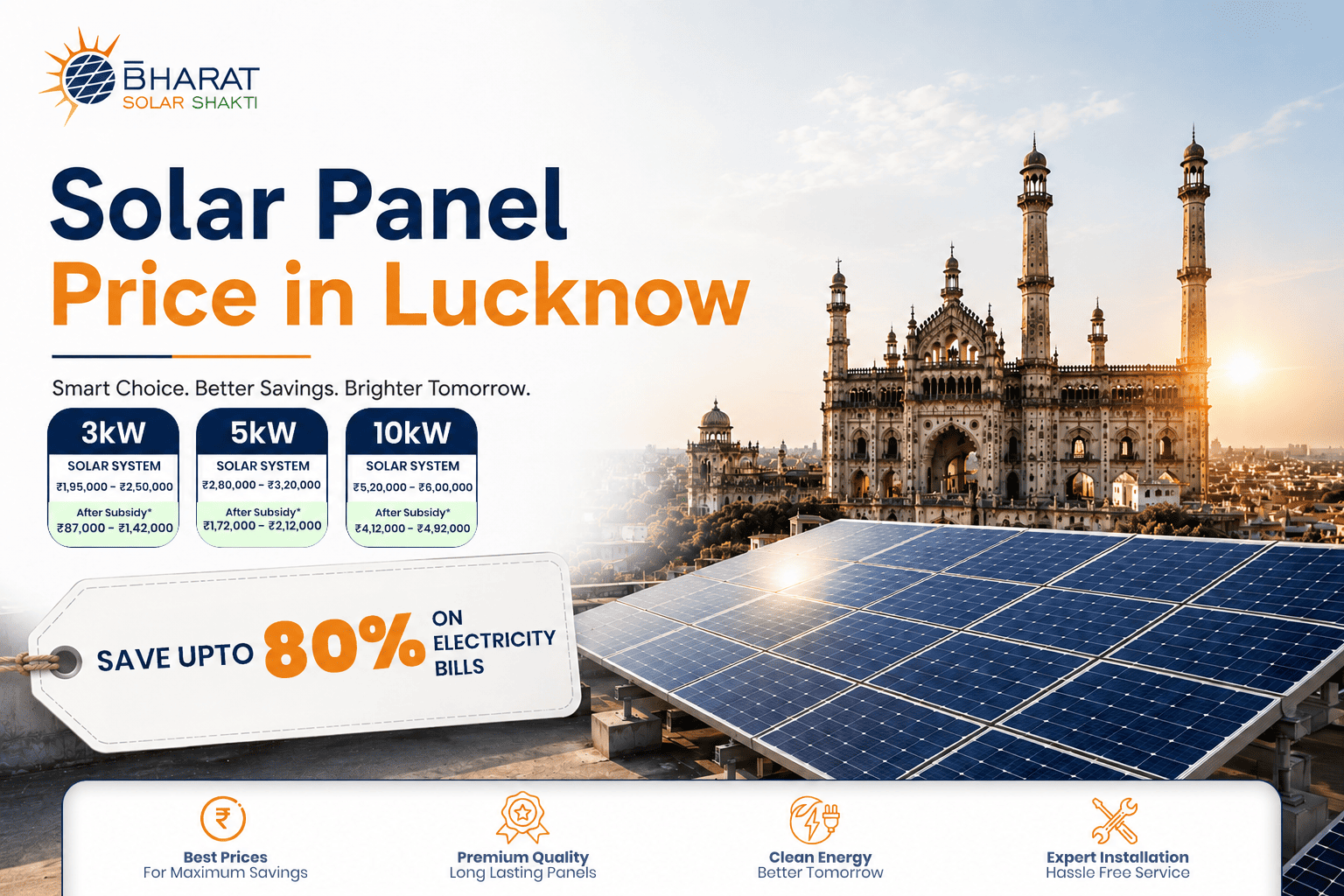
Electricity bills in Lucknow are going up – UPPCL has hiked power tariffs by 10% from June 2026, and for many homeowners, that is the final push to seriously look at solar. The timing actually works in their favour. Solar panel prices have come down to their lowest in years, and Lucknow residents can now claim two separate government subsidies that together bring the upfront cost down by over a lakh rupees.
But the price you see quoted online and the price you actually pay can differ quite a bit depending on your system size, the technology you choose, and who installs it. This guide breaks all of that down, from what a basic 2 kW system costs to what a 10 kW setup sets you back, before and after subsidy, so you know exactly what to budget before you talk to anyone.
What Is the Solar Panel Price in Lucknow in 2026?
The short answer: on-grid solar in Lucknow costs roughly Rs. 45,000 to Rs. 70,000 per kW installed, all-in. So a 3 kW system runs between Rs. 1.35 lakh and Rs. 2.10 lakh before subsidy, and a 5 kW system between Rs. 2.25 lakh and Rs. 3.50 lakh.
The range exists because the system type, panel technology, and inverter brand all affect the final number significantly.
| System Type | Price Range (per kW) |
| On-grid | Rs. 45,000 – Rs. 70,000 |
| Off-grid | Rs. 80,000 – Rs. 1,50,000 |
| Hybrid | Rs. 90,000 – Rs. 1,80,000 |
On-grid systems are the most common choice for Lucknow homes. They connect directly to the MVVNL grid through a net meter, so excess power you generate gets credited against your bill. No battery needed, which keeps costs low. Off-grid and hybrid systems cost significantly more because of battery storage, but they work independently of the grid during power cuts, which matters in parts of Lucknow that still see frequent load shedding.
The key factors that move the needle on price are the panel technology (Mono PERC vs. TOPCon vs. bifacial), the inverter brand and type, the height and complexity of your mounting structure, DISCOM charges, and the installer’s labour and overhead.
Solar Panel Price in Lucknow With and Without Subsidy (2026)
Lucknow homeowners qualify for two subsidies stacked on top of each other: a central subsidy under PM Surya Ghar Muft Bijli Yojana (up to Rs. 78,000) and a UP state subsidy through UPNEDA (up to Rs. 30,000). Together, the maximum subsidy is Rs. 1,08,000 for any on-grid residential system of 3 kW or above.
| System Size | Without Subsidy | After Subsidy (Est.) |
| 2 kW | Rs. 1,20,000 – Rs. 1,60,000 | Rs. 30,000 – Rs. 70,000 |
| 3 kW | Rs. 1,80,000 – Rs. 2,10,000 | Rs. 72,000 – Rs. 1,02,000 |
| 5 kW | Rs. 2,90,000 – Rs. 3,40,000 | Rs. 1,62,000 – Rs. 2,12,000 |
| 10 kW | Rs. 5,00,000 – Rs. 6,00,000 | Rs. 3,92,000 – Rs. 4,92,000 |
The subsidy is credited directly to your bank account after commissioning, not deducted at purchase. For the full step-by-step process, eligibility conditions, and how to apply, read our complete Uttar Pradesh Solar Subsidy Guide.
2 kW, 3 kW, 5 kW and 10 kW Solar System Prices in Lucknow
2 kW Solar Panel Price in Lucknow
A 2 kW system is the entry point for most Lucknow homes. It generates roughly 8 units per day and 2,400 to 2,900 units per year, which covers a monthly electricity bill in the Rs. 1,500 to Rs. 2,500 range.
It is suited to 1 and 2 BHK homes running lights, fans, a refrigerator, a television, and a few small appliances. It cannot power an AC. If your bill is consistently above Rs. 2,500, a 2 kW system will offset part of it but not eliminate it.
| Component | Detail |
| System cost | Rs. 1,20,000 – Rs. 1,60,000 |
| Total subsidy | Rs. 90,000 |
| After subsidy | Rs. 30,000 – Rs. 70,000 |
| Daily output | 8 units (approx.) |
| Roof area | 180 – 200 sq ft shadow-free |
| Best for | 1–2 BHK, bill of Rs. 1,500–Rs. 2,500 |
3 kW Solar Panel Price in Lucknow
A 3 kW system is the most popular size for small to mid-sized Lucknow families. It generates around 12 units per day and 4,200 to 4,800 units per year, which is enough to cover most of a typical 3 BHK household’s consumption excluding AC.
| Component | Detail |
| System cost | Rs. 1,80,000 – Rs. 2,10,000 |
| Total subsidy | Rs. 1,08,000 |
| After subsidy | Rs. 72,000 – Rs. 1,02,000 |
| Daily output | 12 units (approx.) |
| Roof area | 270 – 300 sq ft shadow-free |
| Best for | Small families, bill of Rs. 2,500–Rs. 4,000 |
After the full Rs. 1,08,000 subsidy, a 3 kW system in Lucknow is one of the most cost-effective solar investments available anywhere in India right now.
5 kW Solar Panel Price in Lucknow
A 5 kW system is the standard recommendation for homes with one or two air conditioners. It generates around 20 units per day and 7,000 to 7,500 units per year. Most 3 and 4 BHK homes in Lucknow with AC usage fall into this bracket.
| Component | Detail |
| System cost | Rs. 2,90,000 – Rs. 3,40,000 |
| Total subsidy | Rs. 1,08,000 |
| After subsidy | Rs. 1,62,000 – Rs. 2,12,000 |
| Daily output | 20 units (approx.) |
| Roof area | 450 – 500 sq ft shadow-free |
| Best for | AC users, bill of Rs. 4,000–Rs. 8,000 |
10 kW Solar Panel Price in Lucknow
A 10 kW system serves large homes with multiple ACs and high overall consumption, as well as small businesses and offices. It generates roughly 40 units per day and 14,000 to 15,000 units per year. The subsidy cap stays at Rs. 1,08,000 regardless of system size, so the subsidy benefit as a percentage of cost is lower here, but the monthly savings are significant.
| Component | Detail |
| System cost | Rs. 5,00,000 – Rs. 6,00,000 |
| Total subsidy | Rs. 1,08,000 |
| After subsidy | Rs. 3,92,000 – Rs. 4,92,000 |
| Daily output | 40 units (approx.) |
| Roof area | 900 – 1,000 sq ft shadow-free |
| Best for | Large homes, small businesses, bill above Rs. 8,000 |
How Much Solar System Size Do You Need in Lucknow?
The simplest way to size a solar system is to look at your average monthly electricity bill. Here is a practical framework:
| Monthly Bill | Recommended System Size |
| Rs. 1,500 – Rs. 2,500 | 2 kW |
| Rs. 2,500 – Rs. 4,000 | 3 kW |
| Rs. 4,000 – Rs. 8,000 | 5 kW |
| Rs. 8,000 and above | 10 kW |
Two things to keep in mind. First, a solar system offsets daytime consumption most efficiently. If you run heavy loads like AC mostly at night, you will still offset some costs through net metering credits, but the savings are not as dramatic as for daytime users. Second, always factor in future consumption growth. If you are planning to buy an AC in the next year or two, size up now rather than later.
Real Electricity Bill Scenarios from Lucknow Homes
Scenario 1: Monthly bill of Rs. 2,500
This is a typical 2 BHK household in Lucknow, running ceiling fans, LED lights, a refrigerator, a television, and a washing machine. The monthly consumption is around 200 to 220 units. A 3 kW solar system generating 400 units a month covers this twice over. After subsidy, the system costs around Rs. 72,000 to Rs. 1,02,000. Annual savings: roughly Rs. 24,000 to Rs. 27,000. Payback period: 3 to 4 years.
Scenario 2: Monthly bill of Rs. 5,000
A 3 BHK home with one 1.5-ton AC running 5 to 6 hours a day in summer. Monthly consumption around 400 to 450 units. A 5 kW system generates around 600 units a month, covering the load with surplus to spare via net metering. After subsidy, cost is Rs. 1,62,000 to Rs. 2,12,000. Annual savings: Rs. 48,000 to Rs. 55,000. Payback period: 4 to 5 years.
Scenario 3: Monthly bill of Rs. 10,000
A large 4 or 5 BHK home or a small commercial premises, running multiple ACs and high-load appliances. Monthly consumption of 800 to 900 units. A 10 kW system handles this comfortably and can push surplus units back to the grid for credit. After subsidy, cost is Rs. 3,92,000 to Rs. 4,92,000. Annual savings: Rs. 90,000 to Rs. 1,10,000. Payback period: 4 to 6 years.
How Much Can You Save With Solar in Lucknow?
Savings depend on how much electricity you consume during daylight hours, current MVVNL tariff rates, and how well the system is sized and installed. At current Lucknow residential tariff rates of roughly Rs. 7 to Rs. 8 per unit, here are realistic annual savings estimates:
| System Size | Annual Units Generated | Annual Savings (Est.) |
| 2 kW | 2,800 – 2,900 units | Rs. 20,000 – Rs. 24,000 |
| 3 kW | 4,200 – 4,800 units | Rs. 30,000 – Rs. 38,000 |
| 5 kW | 7,000 – 7,500 units | Rs. 50,000 – Rs. 60,000 |
| 10 kW | 14,000 – 15,000 units | Rs. 1,00,000 – Rs. 1,20,000 |
These figures assume a well-designed system on a south or east-facing roof with minimal shading. Net metering means that units you do not consume during the day are credited to your account and adjusted against your nighttime grid consumption.
Solar Payback Period in Lucknow
The typical payback period for a solar system in Lucknow is 4 to 7 years, depending on system size, tariff rate, subsidy received, and actual consumption. After payback, the system generates free electricity for another 18 to 20 years, since panels are rated for 25 years.
| System | Cost After Subsidy | Annual Savings | Payback Period |
| 2 kW | Rs. 30,000 – Rs. 70,000 | Rs. 20,000 – Rs. 24,000 | 1.5 – 4 years |
| 3 kW | Rs. 72,000 – Rs. 1,02,000 | Rs. 30,000 – Rs. 38,000 | 2 – 4 years |
| 5 kW | Rs. 1,62,000 – Rs. 2,12,000 | Rs. 50,000 – Rs. 60,000 | 3 – 4 years |
| 10 kW | Rs. 3,92,000 – Rs. 4,92,000 | Rs. 1,00,000 – Rs. 1,20,000 | 4 – 5 years |
How Much Electricity Does a Solar System Generate in Lucknow?
Lucknow gets strong sunlight for most of the year, with peak sun hours averaging 4.5 to 5.5 hours per day. Generation varies by season.
| Season | Condition | Generation Trend |
| Summer (March–June) | Intense sun, long days | Highest output, 20–25% above average |
| Monsoon (July–September) | Overcast, humidity | 25–35% lower output |
| Winter (October–February) | Clear skies, shorter days | Moderate, 5–15% below average |
Monthly generation estimates for a 5 kW system in Lucknow:
| Month | Est. Generation |
| January | 500 – 550 units |
| February | 560 – 620 units |
| March | 650 – 700 units |
| April | 700 – 750 units |
| May | 720 – 780 units |
| June | 600 – 650 units |
| July | 450 – 500 units |
| August | 430 – 480 units |
| September | 520 – 570 units |
| October | 580 – 640 units |
| November | 520 – 570 units |
| December | 470 – 520 units |
Annual total: approximately 6,700 to 7,300 units for a well-installed 5 kW system.
On-Grid vs Off-Grid vs Hybrid Solar Cost in Lucknow
| Feature | On-Grid | Off-Grid | Hybrid |
| Grid connection | Yes | No | Yes |
| Battery | No | Yes | Yes |
| Works during outage | No | Yes | Yes |
| Cost (5 kW) | Rs. 2.9L – Rs. 3.4L | Rs. 5.00L – Rs. 6.50L | Rs. 4.50L – Rs. 6.00L |
| Subsidy eligible | Yes | No | Partially |
| Best for | Urban homes, reliable grid | Rural/remote, frequent cuts | Frequent outages, wants grid savings too |
| Payback period | 4 – 6 years | 7 – 10 years | 6 – 9 years |
For most homes in Lucknow with a reasonably reliable MVVNL supply, on-grid is the right choice. It is cheaper, eligible for full subsidy, and the payback period is shorter. Hybrid makes sense for homes in areas with frequent, unpredictable power cuts where losing solar generation during an outage is a real problem.
Solar Battery Cost in Lucknow (2026)
If you are considering a hybrid or off-grid system, batteries are the biggest variable in your total cost. Battery prices in India have dropped 18 to 22% since 2023, and the trend continues, but they remain a significant addition to the system cost.
Lead Acid Batteries
The traditional, affordable option. Suitable for occasional backup use, but they last only 3 to 5 years in Lucknow’s heat, need periodic maintenance, and can only safely discharge 50% of their stored capacity. They look cheap upfront but typically need replacing 2 to 3 times over the lifespan of your solar system.
| Capacity | Price Range (India, 2026) | Brands |
| 3 – 5 kWh | Rs. 25,000 – Rs. 55,000 | Exide, Luminous, Amaron |
Lithium (LiFePO4) Batteries
The better long-term investment for daily solar use. They last 10 to 15 years, require zero maintenance, and can discharge 80 to 90% of their capacity versus 50% for lead acid. In Lucknow’s summer heat, the temperature stability of LiFePO4 chemistry matters significantly.
| Capacity | Price Range (India, 2026) | Notes |
| 3.8 kWh | Rs. 80,000 – Rs. 1,15,000 | Best value lithium entry |
| 5.12 kWh | Rs. 1,30,000 – Rs. 1,65,000 | Popular mid-range |
| 10 kWh+ | Rs. 2,50,000 – Rs. 4,00,000 | Large homes, commercial |
For a typical Lucknow home wanting 4 to 6 hours of backup for essential loads (lights, fans, router), a 3.8 to 5 kWh lithium battery paired with a hybrid inverter is the practical starting point.
What Factors Affect Solar Panel Prices in Lucknow?
Panel Technology
The panel you choose has the biggest impact on both price and long-term output. Mono PERC is the current mainstream standard: 20 to 22% efficiency, widely available, and cost-effective. TOPCon panels are the next generation: 22 to 25% efficiency, lower degradation over time, and better performance in high-heat conditions, but roughly Rs. 5 to Rs. 8 per watt more expensive. Bifacial panels generate power from both sides and work best on rooftops with reflective surfaces beneath them. For most Lucknow residential rooftops, Mono PERC or TOPCon is the right call. Note that UPPCL now requires ALMM-listed panels for net metering approvals in UP, so always confirm ALMM compliance before purchase.
Inverter Brand
The inverter accounts for 15 to 20% of total system cost. For most unshaded rooftops, a string inverter from Sungrow or Growatt is the practical choice: reliable, locally serviceable, and well-priced. For rooftops with partial shading from water tanks, parapets, or trees, SolarEdge optimizers paired with a central inverter give module-level control without the full cost of microinverters. True microinverters are an option for complex multi-orientation rooftops but cost 25 to 40% more.
Roof Type and Structure
A simple flat concrete terrace with no obstructions is the easiest and cheapest to install on. Sloped, tiled, or complex roofs require specialised mounting structures that add Rs. 10,000 to Rs. 40,000 to the cost depending on height and complexity.
Installation Complexity
Higher rooftop floors require more cabling. Older homes may need electrical panel upgrades. Site access for cranes or heavy equipment adds cost. These are all things a proper site visit will surface before quoting.
Hidden Costs Most Solar Buyers Miss
Most solar quotes in Lucknow cover panels, inverter, and basic mounting. Here is what frequently gets added later:
Elevated structure cost: If your roof has obstructions or requires a tilted elevated frame for better sun exposure, that adds Rs. 15,000 to Rs. 50,000 depending on how many panels need elevating.
Earthing and lightning arrester: Mandatory for safe installation and required by DISCOM for net metering approval. Often not in the base quote. Adds Rs. 5,000 to Rs. 10,000.
Net metering charges: MVVNL charges for the bi-directional meter installation, document processing, and site inspection. This runs Rs. 3,000 to Rs. 8,000 and is billed separately by the DISCOM.
Cabling beyond the standard run: If your inverter needs to be placed far from your main panel or the roof is large, cabling costs increase. Each additional 10 metres of DC cable adds Rs. 1,500 to Rs. 3,000.
Battery replacement (for hybrid/off-grid): Lead acid batteries need replacing every 3 to 5 years at Rs. 25,000 to Rs. 55,000. Factor this into your lifetime cost calculation. Lithium batteries eliminate this concern for 10 to 15 years.
Roof waterproofing: Drilling through a terrace for cable runs and structure anchors can compromise waterproofing if done carelessly. A reputable installer uses proper sealant and weatherproofing, but a cheap installer may not. Worth asking about.
How to Compare Solar Quotations in Lucknow
When you receive multiple quotes, do not compare the bottom line alone. Here is the checklist to compare properly:
- Price per watt: Divide the total system cost by the system size in watts. A fair price in Lucknow for a quality on-grid system in 2026 is Rs. 45 to Rs. 65 per watt before subsidy.
- Panel brand and wattage: Confirm the panel is ALMM-listed and from a Tier-1 manufacturer. Check the individual panel wattage, as installers sometimes spec fewer high-wattage panels vs more lower-wattage ones for the same nominal capacity.
- Inverter brand: Sungrow, Growatt, and SolarEdge are established names with local service networks. An unfamiliar brand with no service center in Lucknow is a risk.
- Warranty terms: Panels should carry a 25-year performance warranty. Inverters typically carry 5 to 10 years. Any installer offering less should be questioned.
- Generation guarantee: Some installers offer a first-year generation guarantee. This is a useful indicator of how confident they are in their own workmanship.
- All-inclusive vs exclusive: Confirm whether DISCOM charges, earthing, and net metering are included. If the quote says “excluding DISCOM charges,” ask for the estimated total.
Does It Make Sense to Wait for Solar Prices to Fall?
This comes up often, and the honest answer is: probably not. Solar panel prices have fallen dramatically over the last decade, but most analysts expect the pace of decline to slow significantly from here. Panel manufacturing has already scaled up globally, and further large drops in module costs require step-change improvements in manufacturing technology that are not imminent.
Meanwhile, MVVNL electricity tariffs in Lucknow have increased at roughly 4 to 6% per year historically, and that trajectory is unlikely to reverse. Every month you delay, the electricity bill you are paying is money that solar would have offset. A system installed today with a 4-year payback period starts generating free electricity in 2029. Waiting another year to save Rs. 5,000 to Rs. 10,000 on the system cost means paying another year of full electricity bills, which likely costs more than the price difference.
The current subsidy under PM Surya Ghar is also not guaranteed indefinitely. Policy continuity is a factor worth considering.
How Installer Quality Affects Solar Pricing
A cheaper quote does not always mean a cheaper system over its lifetime. Poor installation quality causes under-generation (a poorly angled panel can lose 10 to 15% output), voided warranties, net metering rejections from MVVNL due to non-ALMM panels or incorrect documentation, and leaking rooftops.
The price difference between a quality installer and a low-cost one is typically Rs. 15,000 to Rs. 40,000 on a 5 kW system. That gap disappears in the first year of under-performance. If you are comparing vendors in Lucknow, our guide to the best solar EPC companies in Lucknow covers what to look for without ranking or endorsing specific vendors.
Frequently Asked Questions (FAQs)