
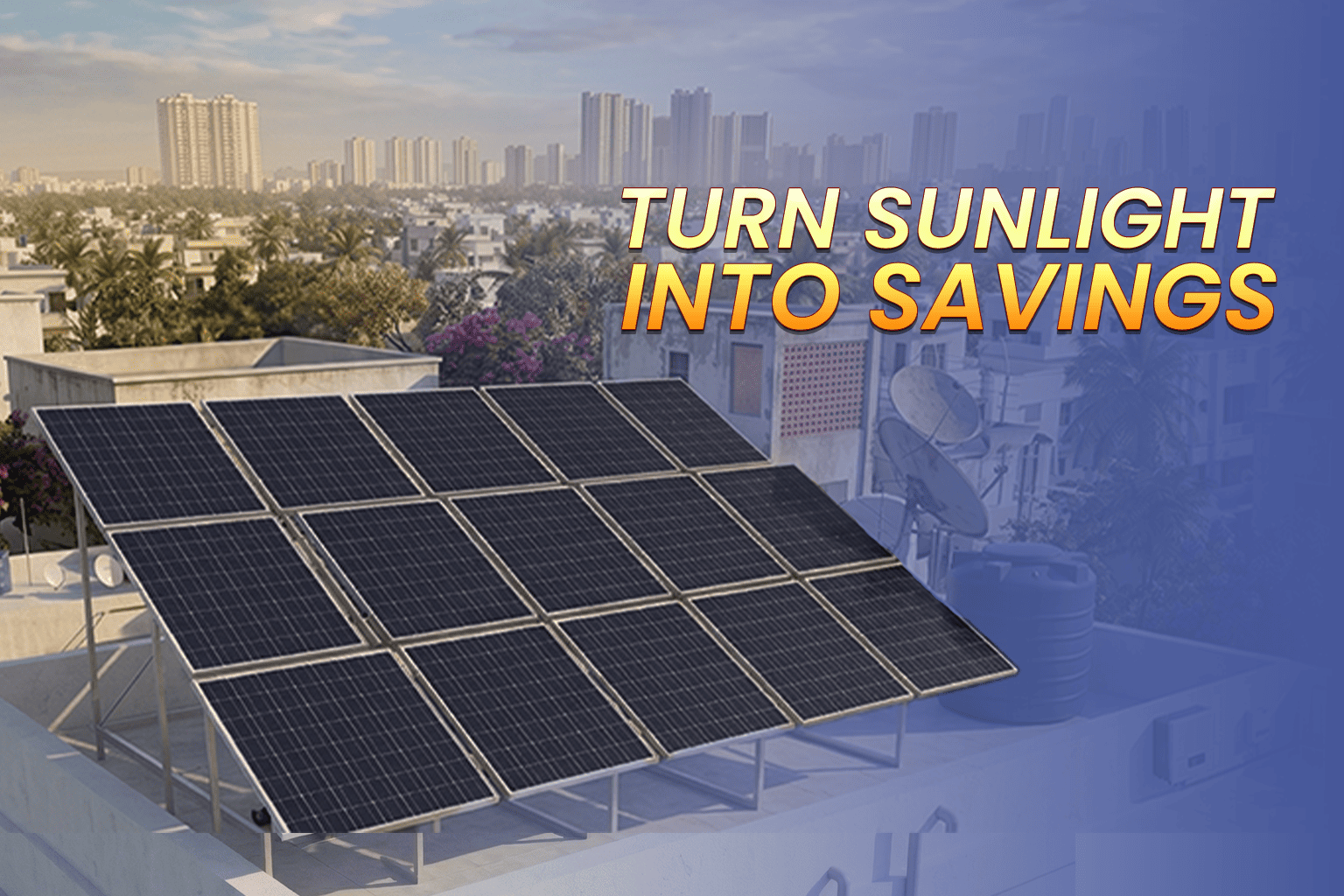
Energy bills are rising. Power cuts are unpredictable. And the planet is asking us to do better. In the middle of all of this, one technology keeps showing up as a clear, practical answer: the solar panel.
But what is solar panel, exactly? How does it turn sunlight into the electricity that powers your lights, fans, and air conditioner? And is it really worth the investment?
In this guide, we break it all down: from the basic definition of a solar panel to how solar panel works, how they are made, and everything you need to know before making a decision. Whether you are a homeowner exploring options or simply curious about renewable energy, this guide has you covered.
What Is A Solar Panel?
A solar panel is a device that captures sunlight and converts it into usable electricity. It is made up of multiple smaller units called photovoltaic (PV) cells, which are the actual workhorses of the panel. When sunlight strikes these cells, they generate an electric current, a process known as the photovoltaic effect.
Solar panels are also commonly referred to as PV panels or solar modules. A group of solar panels connected together forms a solar array, and a complete setup with panels, inverter, mounting structure, and wiring is called a solar power system.
Key Components Of A Solar Panel
Understanding what goes inside a solar panel helps you appreciate why it works so reliably.
- Silicon Solar Cells: The core of every panel. Silicon is a natural semiconductor that conducts electricity under specific conditions, making it ideal for converting sunlight into current. Most panels use either monocrystalline or polycrystalline silicon cells.
- Tempered Glass Sheet: Sits on top of the cells to protect them from rain, hail, dust, and UV damage, while still allowing sunlight to pass through efficiently.
- EVA (Ethylene Vinyl Acetate) Encapsulant: A clear adhesive layer that bonds the glass, cells, and backsheet together, providing insulation and moisture resistance.
- Backsheet: A durable polymer layer on the underside of the panel that protects against electrical faults, corrosion, and weather exposure.
- Aluminium Frame: Provides structural strength, keeps all layers securely in place, and allows for easy mounting on rooftops or ground systems.
- Junction Box: Located at the back of the panel, this houses the electrical connections and diodes that prevent reverse current flow, ensuring the electricity generated reaches your inverter safely.
How Do Solar Panels Work?
At the heart of every solar panel is a remarkably elegant process. Here is a step-by-step breakdown of how solar panels work, from sunlight hitting the panel to electricity powering your home.
Step 1: Sunlight Strikes The Solar Cells
When sunlight (made up of photons) hits the silicon solar cells in a panel, those photons carry enough energy to knock electrons loose from their atoms. This is the photovoltaic effect, and it is what makes solar energy possible.
Step 2: Direct Current (DC) Is Generated
The freed electrons begin to move through the silicon cell, creating an electric current. However, this current is Direct Current (DC), the same type of current produced by a battery. Most home appliances, however, run on Alternating Current (AC).
Step 3: The Inverter Converts DC To AC
This is where the solar inverter comes in. The DC electricity from your panels flows into the inverter, which converts it into AC electricity that can power your home’s lights, fans, appliances, and air conditioners. There are different types of inverters: string inverters, microinverters, and power optimisers, each suited to different system sizes and configurations.
Step 4: Electricity Powers Your Home (Or Feeds The Grid)
The converted AC electricity is distributed through your home’s electrical panel (the fuse box). If your solar system produces more electricity than your home needs at that moment, the surplus is either:
- Stored in a solar battery for later use (such as during evenings or power cuts), or
- Exported to the electricity grid, often earning you credits under net metering policies.
Step 5: Net Metering And Grid Connection
In India, net metering allows you to sell excess solar power back to the grid. This means your electricity meter runs backwards when you are producing more than you consume, significantly reducing your monthly bill and, in some cases, bringing it close to zero.
What Affects Solar Panel Efficiency?
Not all panels perform the same in all conditions. Here are the key factors:
- Sunlight intensity – More direct sunlight means more electricity generated.
- Panel angle and orientation – In India, panels ideally face south at an angle matching the local latitude.
- Temperature – Surprisingly, extreme heat can slightly reduce efficiency. High-quality panels are designed to minimise this.
- Shading – Even partial shading on one panel can reduce output across the system. Good system design avoids shading wherever possible.
- Panel quality – Premium panels with higher efficiency ratings produce more power per square metre.
How Are Solar Panels Made?
The process of manufacturing a solar panel is a fascinating journey from sand to clean energy. Here is how it happens.
Step 1: Silicon Extraction And Purification
It all starts with ordinary sand. Sand contains silicon dioxide, which is heated in high-temperature industrial furnaces with carbon to extract pure silicon. This raw silicon is then chemically refined into polysilicon, with a purity level exceeding 99.9999%, because even trace impurities can reduce the efficiency of the final panel.
Step 2: Silicon Ingot Formation
The purified silicon is melted and formed into solid blocks called ingots. For monocrystalline panels, a single crystal seed is used to grow a uniform ingot. For polycrystalline panels, multiple silicon crystals are melted and poured into a mould.
Step 3: Slicing Into Wafers
These ingots are sliced into ultra-thin wafers, typically less than 1 mm thick, using precision wire saws. Each wafer is then polished, cleaned, and inspected for defects.
Step 4: Doping And Creating The P-N Junction
Pure silicon cannot conduct electricity on its own. To make it useful, manufacturers dope the wafers by adding trace elements:
- Boron creates a positively charged (P-type) layer.
- Phosphorus creates a negatively charged (N-type) layer.
Together, these two layers form a P-N junction, an internal electric field that drives electrons in one direction when sunlight hits the cell, creating usable current.
Step 5: Adding Anti-Reflective Coating And Metal Contacts
An anti-reflective coating is applied to ensure that maximum sunlight is absorbed rather than reflected away. Fine silver lines are then screen-printed onto the surface of each wafer, serving as electrical contacts that collect and carry the generated electrons out of the cell.
Step 6: Cell Assembly Into A Module
Individual cells are interconnected using conductive ribbons, then arranged in rows and columns. A typical 60-cell panel uses six strings of ten cells each. These interconnected cells are then layered between a glass sheet and a backsheet, bonded together with EVA encapsulant.
Step 7: Lamination And Framing
The entire assembly is laminated using heat and pressure to create a weatherproof, durable module. An aluminium frame is then fitted around the panel for structural support, and a junction box is attached to the rear. Finally, every panel undergoes rigorous testing, including electroluminescence (EL) testing, flash testing for power output, and mechanical load testing, before it is cleared for installation.
Where Can Solar Panels Be Installed?
One of the biggest advantages of solar panels is their versatility. They can be installed across a wide range of settings, making them a practical energy solution for almost everyone.
Residential Installations-
Solar panels are most commonly installed on the rooftops of homes and apartments. A residential solar system typically ranges from 2 kW to 10 kW, depending on the household’s energy consumption. Homeowners benefit from reduced electricity bills, protection against rising power tariffs, and in many cases, government subsidies under schemes like PM Surya Ghar Muft Bijli Yojana.
Commercial Installations-
Offices, retail stores, hotels, hospitals, and other commercial establishments are increasingly adopting solar energy to cut operational costs. Commercial solar systems are larger in capacity and are often installed on flat rooftops or open areas within the premises. With higher daytime energy consumption, businesses tend to see a faster return on investment compared to residential users.
Industrial Installations-
Factories, warehouses, and manufacturing units are among the largest consumers of electricity in India. Industrial solar installations, often ground-mounted or installed on large shed rooftops, can be several megawatts in capacity. For industries with high power bills, solar energy offers significant cost savings and helps meet sustainability targets.
Conclusion
A solar panel is far more than a slab of glass on your rooftop. It is the result of advanced materials science, precision engineering, and a deep understanding of how light interacts with matter. From silicon extracted from sand, to a P-N junction generating electrons, to your AC finally coming on in a power cut, every step in the process is built to deliver clean, reliable energy for 25 years or more.
The question is no longer whether solar makes sense. For most Indian homes and businesses, it absolutely does. The question is when, and the honest answer is: the sooner, the better.Ready to make the switch? Explore our solar solutions and let our experts design a system built for your home, budget, and energy needs.
Frequently Asked Questions (FAQs)