India receives some of the highest solar irradiance in the world, with over 300 sunny days a year in most states. It is no surprise that solar energy has become one of the fastest-growing sectors in the country. But before you invest in a solar system, one question comes up almost every time: which type of solar panel should I choose?
Understanding the different types of solar panels available in India can help you make a smarter, more cost-effective decision. Whether you are setting up rooftop solar for your home, running a commercial unit, or managing a large industrial facility, this guide breaks down all major solar panel types, compares their cost, lifespan, and efficiency, and tells you exactly which one suits your needs.
Comparison of Solar Panels in India
Here is a quick look at how the most common types of solar panels in India stack up against each other:
| Type of Solar Panel | Efficiency | Lifespan | Approximate Cost (per watt) | Best For |
| Monocrystalline | 20–23% | 25–30 years | ₹30–₹50 | Homes, small rooftops |
| Polycrystalline | 15–18% | 20–25 years | ₹20–₹35 | Large rooftops, budget installs |
| Thin-Film (CIGS/CdTe) | 10–13% | 10–20 years | ₹15–₹25 | Industrial sheds, curved surfaces |
| Bifacial | 22–25% | 25–30 years | ₹40–₹60 | Ground-mounted, open terraces |
| PERC | 21–24% | 25–30 years | ₹35–₹55 | Homes with limited roof space |
Note: Costs mentioned are indicative and may vary based on brand, wattage, and installation complexity. Contact us for an accurate quote.
Different Types of Solar Panels in India
Solar panels have evolved significantly over the decades. They are broadly classified into three generations, each representing a leap in technology and application.
Before diving into each type, if you want to understand the basics of how a solar panel actually converts sunlight into electricity, check out our beginner-friendly guide: What Is a Solar Panel and How Does It Work?
First Generation Solar Panels (Crystalline Silicon)
First-generation panels are the most widely used in India today. They are made from silicon crystals and are known for their high efficiency and long lifespan.
1. Monocrystalline Solar Panels
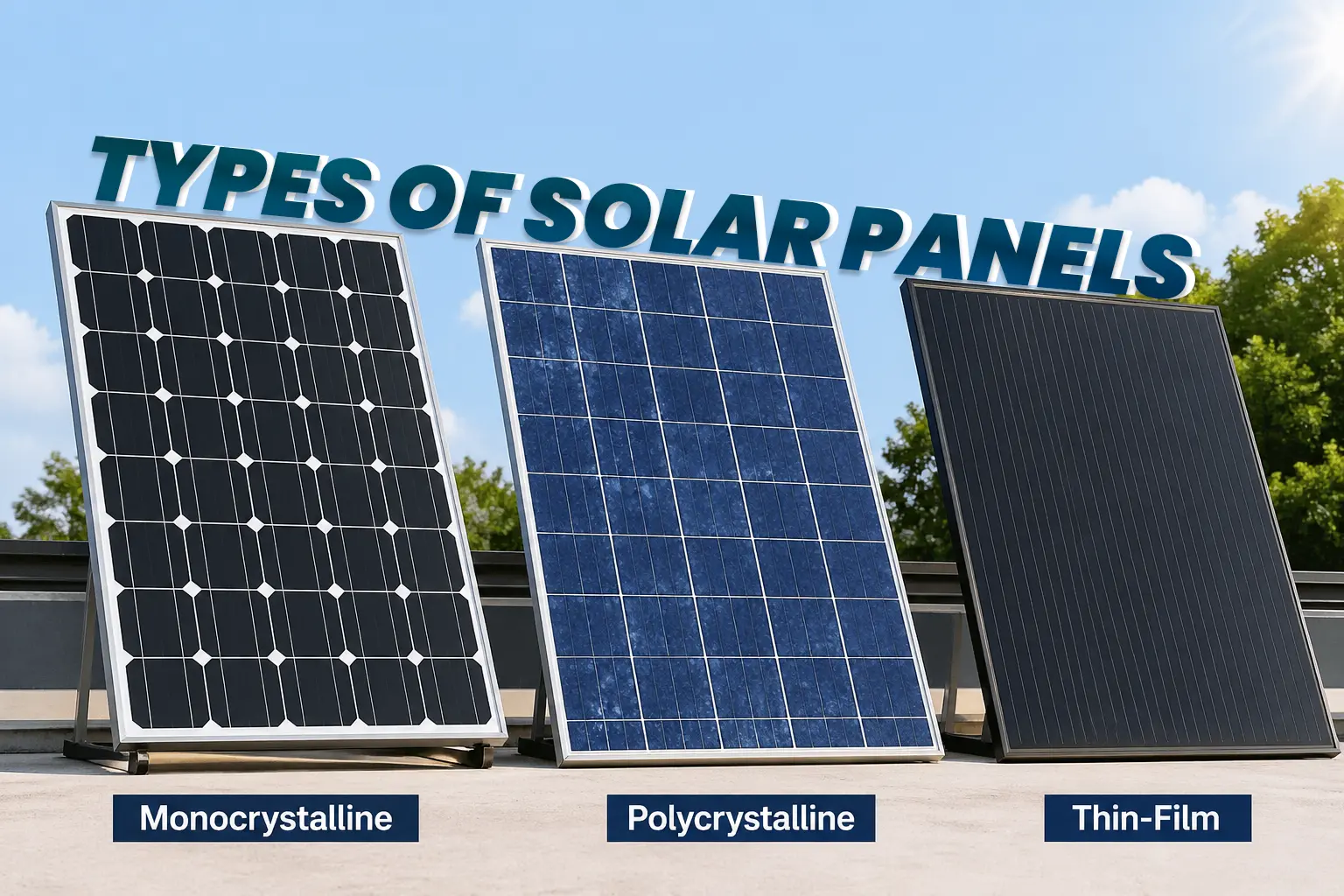
Monocrystalline panels are made from a single, pure silicon crystal. They are the most efficient solar panels currently available for residential use.
- Efficiency: 20–23%
- Lifespan: 25–30 years
- Advantages: Highest efficiency, sleek black appearance, performs well in low-light conditions, space-efficient
- Disadvantages: More expensive than other types, slightly affected by high temperatures
- Best For: Homes, urban rooftops, and spaces with limited area
If you are planning to install solar for your home, monocrystalline panels are often the top recommendation. Learn more about what a residential solar system looks like and what it costs for Indian homes.
2. Polycrystalline Solar Panels
Polycrystalline panels are made by melting multiple silicon crystals together. They have a distinctive blue, speckled appearance.
- Efficiency: 15–18%
- Lifespan: 20–25 years
- Advantages: Lower cost, widely available, good performance in high-heat conditions
- Disadvantages: Lower efficiency than monocrystalline, require more space for the same output
- Best For: Large rooftops, agricultural pumping, budget-conscious installations
Polycrystalline panels have historically been the most popular choice in India due to their affordability, though monocrystalline panels are rapidly gaining ground as prices drop.
Second Generation Solar Panels (Thin-Film)
Second-generation panels use thin layers of photovoltaic material deposited on glass, plastic, or metal. They are lighter and more flexible than crystalline panels.
3. Thin-Film Solar Panels
Thin-film panels include technologies like Cadmium Telluride (CdTe), Amorphous Silicon (a-Si), and Copper Indium Gallium Selenide (CIGS).
- Efficiency: 10–13%
- Lifespan: 10–20 years
- Advantages: Lightweight, flexible, performs better in diffuse or cloudy light, lower manufacturing cost
- Disadvantages: Lowest efficiency, requires significantly more space, shorter lifespan
- Best For: Industrial sheds, warehouses, curved rooftops, utility-scale projects with ample land.
While thin-film is less common in Indian homes, it finds good use in large industrial setups where space is not a constraint and weight matters.
Third Generation Solar Panels (Advanced Technologies)
Third-generation panels represent the cutting edge of solar technology. They include bifacial, PERC, and emerging technologies like perovskite cells.
4. PERC Solar Panels (Passivated Emitter and Rear Cell)
PERC panels are an advancement over standard monocrystalline technology. They have a special reflective layer on the back that captures light that would otherwise be wasted.
- Efficiency: 21–24%
- Lifespan: 25–30 years
- Advantages: Higher output than standard mono panels, performs well in low light and high temperatures, ideal for limited roof space
- Disadvantages: Slightly higher cost than standard monocrystalline
- Best For: Residential rooftops, urban buildings with space constraints
PERC panels are quickly becoming the preferred choice for Indian homeowners looking for the best performance in a compact footprint.
5. Bifacial Solar Panels
Bifacial panels generate electricity from both sides: front and rear. They capture direct sunlight from the front and reflected light (albedo) from the ground or surface below.
- Efficiency: 22–25% (and higher with ground reflection)
- Lifespan: 25–30 years
- Advantages: Higher energy yield, durable glass-on-glass construction, excellent for open spaces
- Disadvantages: Higher upfront cost, requires open reflective ground surface to maximise rear gain
- Best For: Ground-mounted systems, large open terraces, solar farms, commercial projects
Bifacial panels are especially popular in commercial settings with large open rooftops or ground space. If you run a business or operate a facility, explore our commercial solar solutions to find out which panel type and system size is right for you.
How Much Do Solar Panel Systems Cost in India?
The cost of a solar system depends on the type of panel, system size, and whether you are claiming a government subsidy.
Without Subsidy
| System Size | Approximate Cost | Suitable For |
| 1 kW | ₹60,000 – ₹80,000 | Small homes (1–2 BHK) |
| 3 kW | ₹1,50,000 – ₹2,00,000 | Medium homes (2–3 BHK) |
| 5 kW | ₹2,50,000 – ₹3,50,000 | Large homes, small businesses |
| 10 kW | ₹5,00,000 – ₹7,00,000 | Commercial units, offices |
With PM Surya Ghar Subsidy
The Government of India’s PM Surya Ghar Muft Bijli Yojana offers significant subsidies for residential rooftop solar installations:
- Up to 2 kW: ₹30,000 per kW subsidy
- 2 kW to 3 kW: ₹18,000 per kW (for the additional capacity)
- Above 3 kW: Fixed subsidy of ₹78,000
This means a 3 kW system that costs around ₹1,75,000 could effectively cost you just ₹97,000 after subsidy, making solar energy more accessible than ever.
For businesses and industrial consumers, separate state-level incentives and accelerated depreciation benefits under the Income Tax Act are also available.
For more details on India’s solar energy policies, refer to the Ministry of New and Renewable Energy (MNRE) official website.
Why Bharat Solar Shakti Is the Right Choice for Your Solar Needs
Choosing the right solar panel is only half the decision. Choosing the right solar partner matters just as much.
At Bharat Solar Shakti, we have helped hundreds of homes, businesses, and institutions across India make the switch to clean, reliable solar energy. Here is what sets us apart:
- Quality Products Only: We work with Tier-1 solar panel manufacturers and certified components, with no compromises on quality.
- End-to-End Installation: From site survey and system design to installation and commissioning, we handle everything.
- Government Subsidy Assistance: Our team helps you claim every rupee of subsidy you are entitled to.
- Performance Guarantee: We back every installation with a performance guarantee, so your system generates what we promise.
- After-Sales Support: Our trained technicians are available for maintenance and troubleshooting whenever you need them.
- Tailored Solutions: Whether you need a residential solar system or a commercial solar setup, we design the right system for your load and budget.
Ready to switch to solar? Get a free consultation with our experts today.
Conclusion
India’s solar market offers a panel for every need and budget. Monocrystalline and PERC panels are ideal for homes with limited roof space. Polycrystalline panels work well for budget-focused large installations. Bifacial panels deliver the best output for open, ground-mounted setups. Thin-film panels are suited for industrial applications where flexibility matters more than efficiency.
With government subsidies bringing costs down and electricity prices rising, there has never been a better time to go solar. Choose the right type of solar panel for your requirements and let a trusted installer like Bharat Solar Shakti handle the rest.
Frequently Asked Questions (FAQs)